Ask around at any trailhead and you'll hear a version of the same story: a brand-new bike, a hastily strapped trunk rack, and a rearview-mirror moment on the interstate — the rack shifting an inch, then another — that ends with hazards on in the right lane at 45 miles per hour. Cyclists' forums are full of these near-misses, and they almost always trace back to the same thing: a rack that was wrong for the job, or right for the job and strapped in a hurry.
A bike rack is one of those purchases where the price of getting it wrong isn't the rack. It's the bike. And increasingly — with e-bikes pushing 60 pounds and nice mountain bikes clearing five grand — it's a lot of bike.
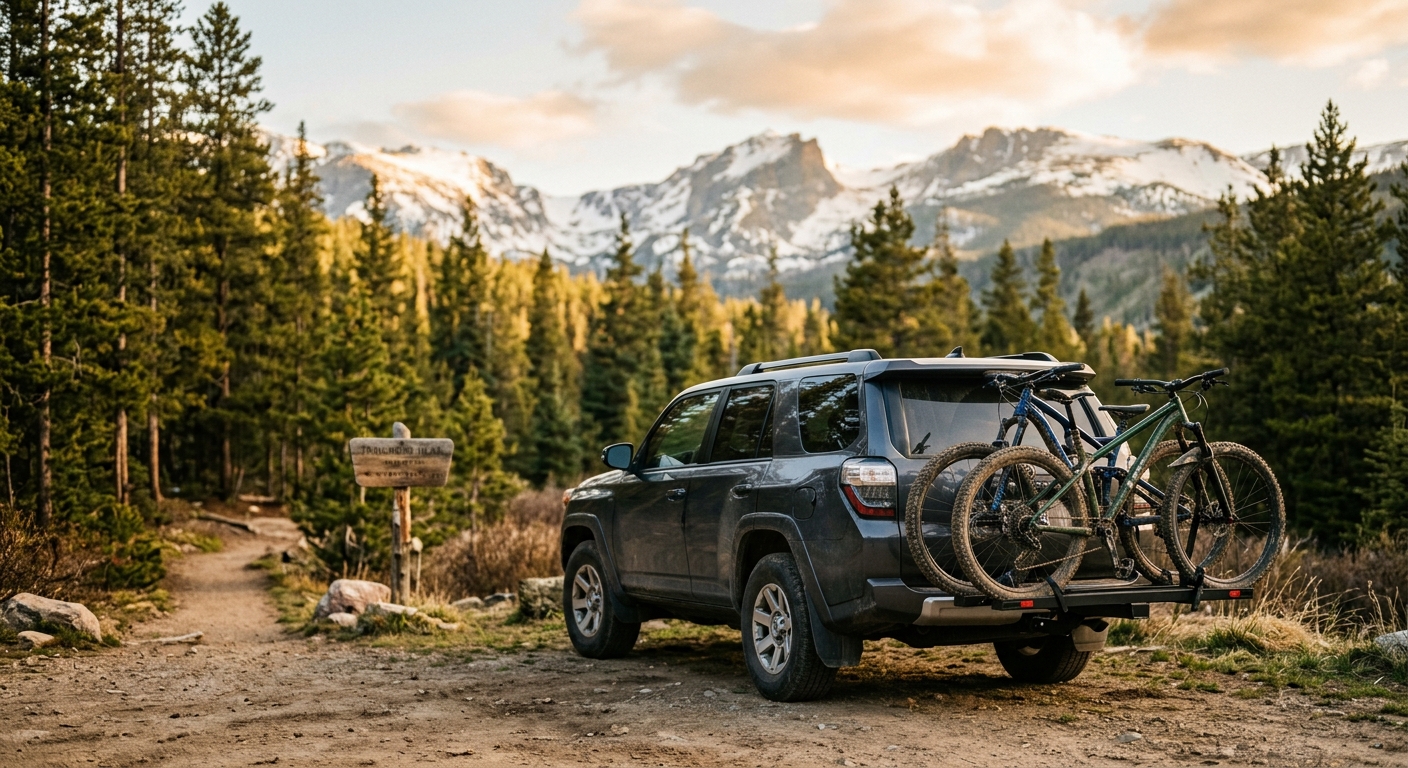
It's the first week of April, the trails are melting out, and if you bought a new bike over the winter (or you're about to), this is the moment to sort out how it gets to the trailhead. So here's our honest guide to the racks we'd actually bolt to our own cars, plus the stuff nobody tells you about tongue weight, receivers, and why your garage door is the roof rack's natural predator.
First, the Honest Version: Hitch vs. Trunk vs. Roof
Every rack guide pretends these three styles are equal contenders. They're not, so let's just say it: for most people, a hitch-mounted platform rack is the answer, and the only real question is which one. Platform racks hold the bike by its wheels (no paint-rubbing frame contact), load at knee height instead of over your head, don't care whether your bike is carbon, full-suspension, or a kids' 20-inch, and sit rock-solid at highway speed. The catch is you need a hitch receiver — figure $150-350 installed if your car doesn't have one — and the good racks aren't cheap.
Trunk racks are the budget path and the renter's path: no hitch needed, one rack moves between cars, and the good ones are genuinely secure when strapped correctly. The trade-offs are frame contact, fiddly setup, no tailgate access with bikes loaded, and the quiet truth that most horror stories involve a trunk rack strapped in a hurry.
Roof racks hold a strange position: they're the most secure attachment to the car and the most dangerous place for a bike. Nothing back there to scrape or jackknife into, full trunk access, and they look great. But you're lifting a bike overhead (miserable with anything over 35 pounds), you'll pay 10-25 percent of your gas mileage as a rooftop tax at highway speed, and one distracted pull into a parking garage or your own garage ends everything. Everyone who's owned a roof rack for ten years has either done it or had the near-miss that still makes their stomach drop. Buy a roof rack if you need one — we recommend a great one below — just go in with clear eyes and a sticky note on your dashboard.
Our Picks
Best Overall: Thule T2 Pro XTR
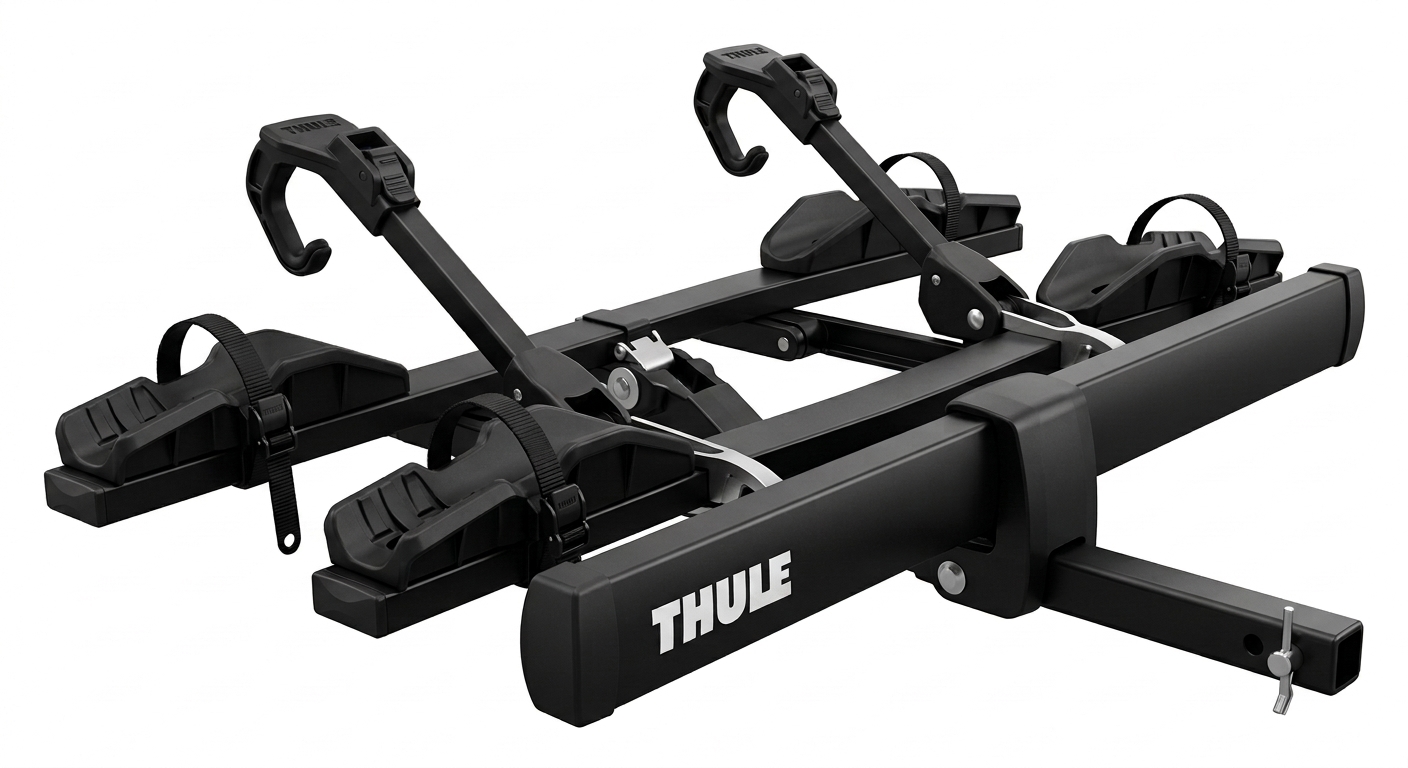
The T2 Pro is the rack we point friends to when they say "just tell me what to buy." Two trays rated by Thule at 60 pounds each, wheel-clamp arms that never touch the frame, and tool-free adjustment that handles everything from a 5-inch fat-bike tire to a kids' 20-inch wheel. The detail that earns the price, though, is the tilt: a lever at the end of the rack — reachable without crawling under your bikes — drops the whole thing away from the car so you can open the tailgate with both bikes loaded. If you've ever crawled under a muddy bumper to yank a stiff pin while two loaded bikes wobbled over your head, you know that lever is less a luxury than a relationship-saver. It's 52 pounds of aluminum and it feels like it: solid, no wobble, no rattle, none of that nervous shimmy in the mirror. The T2 Pro has a strong reputation among owners for holding up to years of rough forest-road use with little more maintenance than an occasional hose-down. It's expensive. It's also the last rack most people buy.
Price: Premium — check retailer for current pricing | Capacity: 2 bikes, 60 lb/tray (Thule-rated) | Rack weight: 52 lb | Access: Lever tilt with bikes loaded | Available at: Thule, REI, Backcountry
Best for E-Bikes: Thule EasyFold XT 2
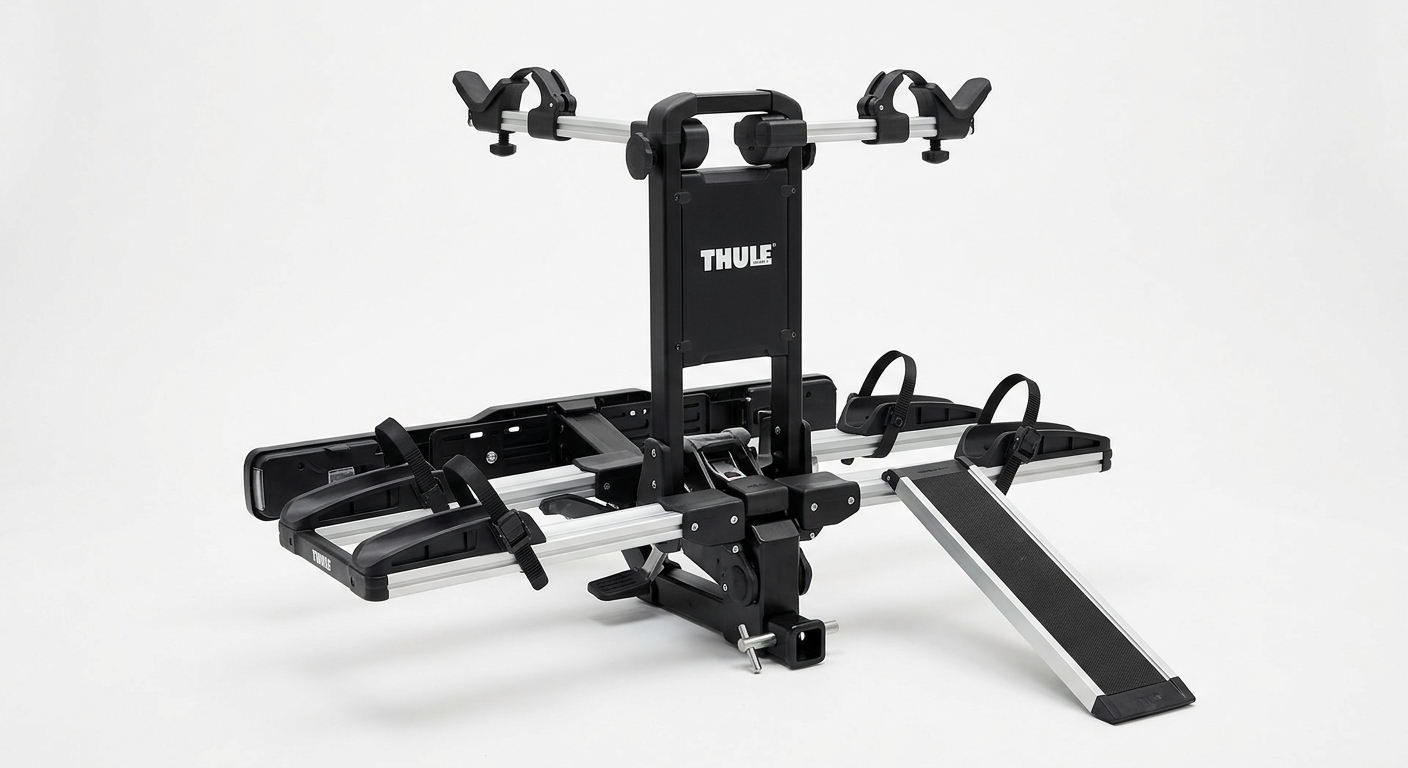
Here's the quiet reality of e-bikes: they're heavy, and lifting 55 pounds of awkward rolling metal at arm's length while threading a wheel into a tray is how backs end. The EasyFold's answer is a ramp. It stows inside the rack, clicks into the tray, and you roll the bike up instead of lifting it — which sounds like a small thing and is actually the entire difference between riding your e-bike places and leaving it home. Each tray is rated by Thule at 65 pounds, the frame clamps ratchet down on wide e-bike tubes without drama, and when you're not using it the whole rack folds into a suitcase shape with a carry handle, so it lives in a closet instead of permanently hanging off your bumper. It's the most expensive rack here, and we'd still call it the easiest recommendation in the roundup: it has become something close to the default answer among regular e-bike haulers.
Price: Premium — check retailer for current pricing | Capacity: 2 bikes, 65 lb/tray (Thule-rated) | Rack weight: 45 lb | Access: Foot-pedal tilt; folds flat for storage | Available at: Thule, REI
Best Value Hitch Rack: Kuat Transfer v2
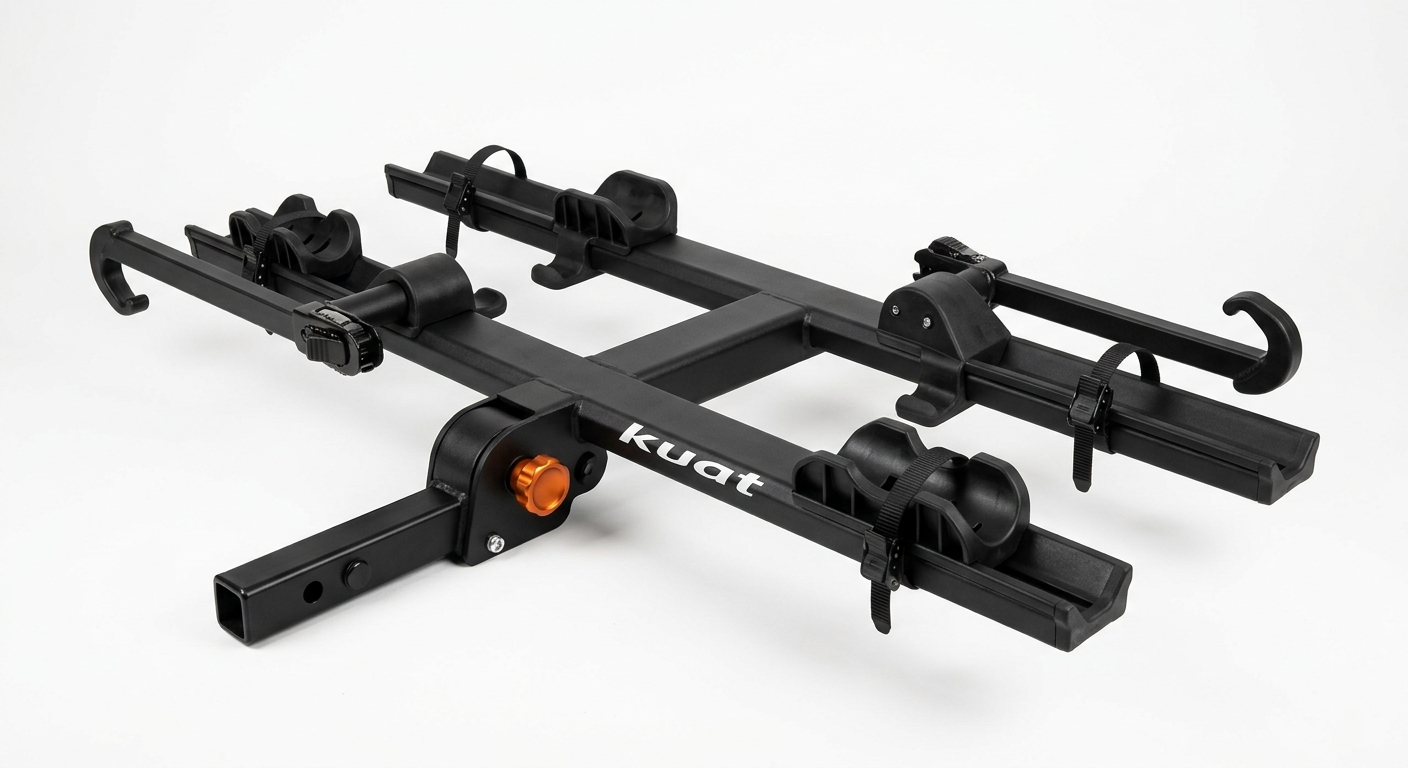
The Transfer v2 is what happens when a company known for premium racks builds a mid-priced one without phoning it in. You still get a true platform design rated by Kuat at 60 pounds per tray, wheel-cradle arms that skip the frame entirely, and — this is the part that surprises people at the price — a real tilt lever that works with bikes loaded. What you give up versus the premium racks is mostly refinement: the finish is powder-coated steel instead of sculpted aluminum, the adjustments take a few more seconds, and at 37 pounds it's actually lighter to wrestle onto the hitch than our top pick. The little orange anodized knobs are a nice reminder that somebody at Kuat cared. If the T2 Pro's price made you exhale through your teeth, buy this and spend the difference on gas money to somewhere good. We like Kuat enough, in fact, that a Kuat hitch rack is part of our sweepstakes prize lineup — no purchase necessary, and the sweepstakes page has the details and official rules.
Price: Mid-range — check retailer for current pricing | Capacity: 2 bikes, 60 lb/tray (Kuat-rated) | Rack weight: 37 lb | Access: Foot-assist tilt with bikes loaded | Available at: REI, Backcountry, evo
Best Trunk Rack (and Best Budget): Saris Bones EX
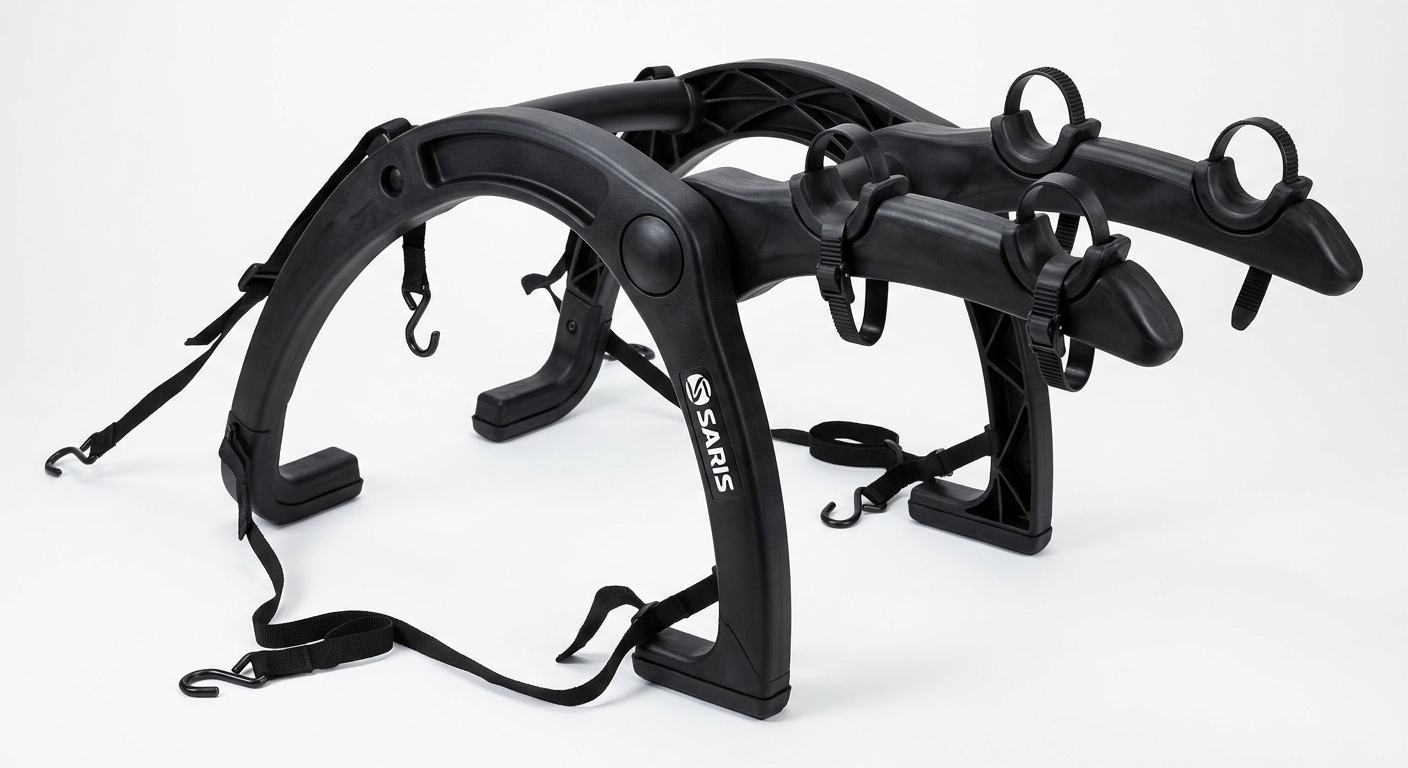
Yes, we opened this article with trunk rack horror stories, and yes, we're recommending a trunk rack anyway — because the Bones is the one that's earned it. It's been around in some form since the 90s for a reason: the arc-shaped frame is injection-molded like it came out of a design museum, the legs spread wide to sit on the strongest parts of your trunk, and the EX version fits the spoilers and curvy hatches that defeat flat-legged racks. It weighs eleven pounds, moves between cars in five minutes, and carries three bikes for a fraction of what the hitch racks here cost. The honest caveats: the cradle arms hold bikes by the frame, so it's awkward with step-through and full-suspension designs (Saris sells an inexpensive adapter bar that fixes this), and a trunk rack is only as secure as your strap-tightening discipline. Do the shake test before every drive — grab the rack and try to move it hard — and re-snug the straps 20 minutes into the first trip. Do that, and the Bones will outlive your car.
Price: Budget — check retailer for current pricing | Capacity: 3 bikes, 35 lb each (Saris-rated) | Rack weight: 11 lb | Fits: Most sedans, hatchbacks, and SUVs, including many spoilers | Available at: REI, evo
Best Roof Rack: Thule TopRide
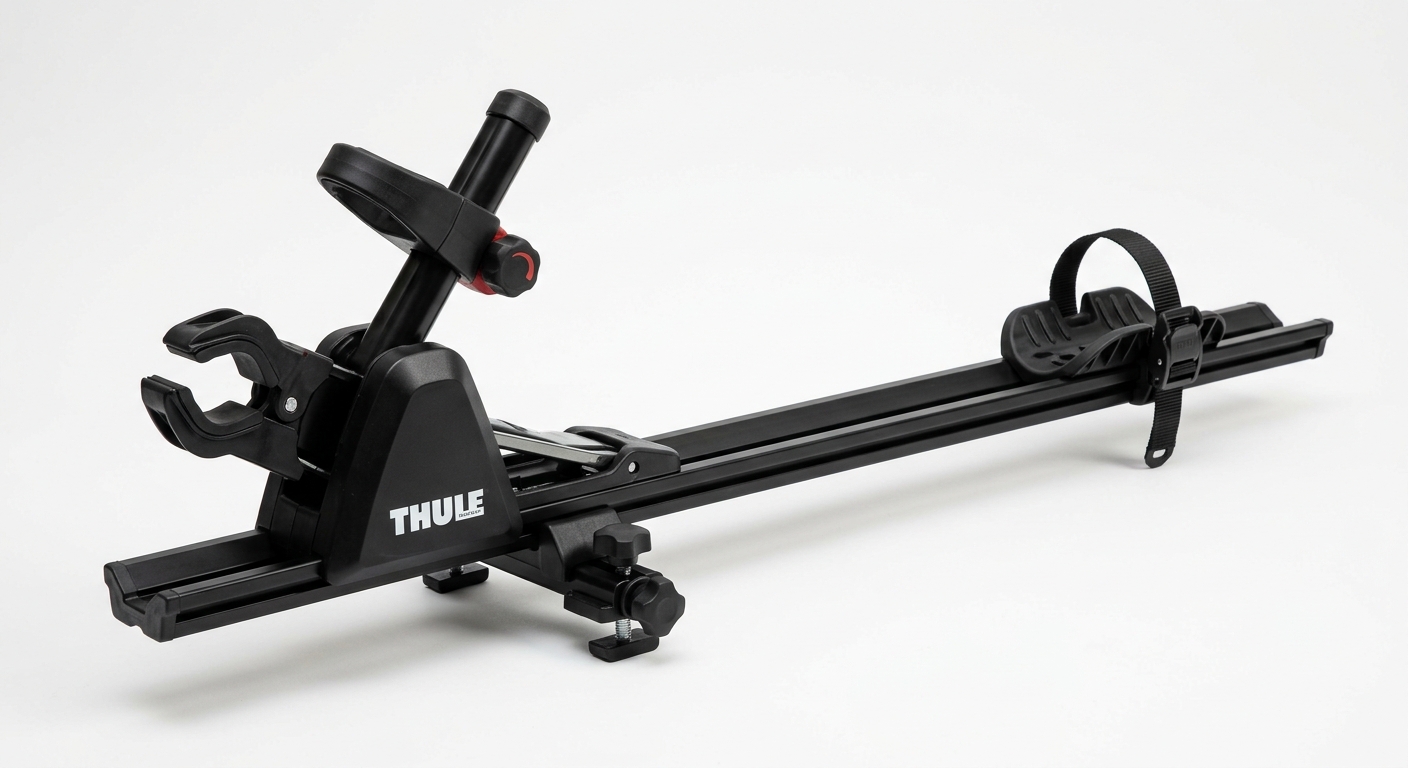
If the roof is your answer — truck bed full of other gear, hitch occupied by a trailer, or you just like the look — the TopRide is the one we trust. The front jaw clamps the wheel, not the fork or the frame, so there's no paint contact, no adapter roulette with thru-axles, and no torque-spec anxiety with a carbon frame. Loading is genuinely one-handed once you've done it twice: set the front wheel in the jaw, crank the knob until it's snug, ratchet the rear strap. It fits tires up to three inches wide, takes bikes up to 44 pounds by Thule's rating (though see our note below about lifting), and locks to the crossbar with the same key as your other Thule stuff. One per bike, so a family fleet gets expensive fast, and we'll say it one more time because we love you: measure your garage door, write the clearance height on a sticky note, and put it on the dash. Not kidding.
Price: Mid-range — check retailer for current pricing | Capacity: 1 bike, up to 44 lb (Thule-rated) | Rack weight: 18 lb | Fits: Tires up to 3 in wide, no frame contact | Available at: Thule, REI, Competitive Cyclist
The 1.25-Inch vs. 2-Inch Receiver Question
If you're adding a hitch to your car just for bikes, here's the short version: get the 2-inch receiver if your car supports it. The hole in the middle of the hitch comes in two sizes, and while most racks ship in both versions, the 1.25-inch class is the compromise nobody mentions until you own one. Smaller receivers are usually rated for less tongue weight (often 200 pounds versus 350-plus), they flex more, which shows up as rack wobble at speed, and the add-on trays that expand two-bike racks to four almost universally require the 2-inch version. The price difference at install time is usually zero to fifty dollars. The regret difference, when you buy an e-bike two years from now and discover your receiver can't legally carry it plus the rack, is considerably larger.
The E-Bike Weight Reality Check
Speaking of which — this is the math everyone skips, so let's do it out loud. A hitch receiver has a tongue-weight rating: the total vertical load it can carry. Say yours is rated for 200 pounds. The EasyFold weighs 45 pounds. Two mid-size e-bikes at 55 pounds each is another 110. That's 155 pounds hanging off your bumper before anyone adds a battery, a fender, or the lock in the frame bag — fine on a 200-pound rating, but swap in two 65-pound cargo-ish e-bikes and you're at 175 with no margin for the rack bouncing over potholes, which effectively multiplies the load. Check three numbers before you buy: your hitch's tongue rating (stamped on the receiver or in the manual), your rack's per-tray limit, and your bikes' actual weight with batteries in. Bathroom-scale your bike if you have to — manufacturers quote weights the way restaurants photograph burgers. And pull the batteries before you lift: that's 7-10 pounds less strain on your back, and the electronics would much rather ride in the climate-controlled cabin with you anyway.
Locks, Hitch Pins, and Keeping Your Bikes Yours
A rack introduces two theft problems people don't think about until the bad day: someone stealing the bikes off the rack, and someone stealing the rack itself. For the rack, replace the plain hitch pin — the one anyone with hands can pull in four seconds — with a locking hitch pin; it's $20-40 and it's the single best security dollar in this article. For the bikes, the integrated cable locks on racks like the T2 Pro are honest-to-goodness deterrents for the gas-station stop and nothing more: a cable that thin surrenders to hand cutters in seconds. Our rule is the coffee test. If the bikes will be out of sight longer than it takes to buy a coffee, a real u-lock or folding lock goes through a wheel and frame to the rack. Longer than a meal, the bikes come inside. No rack is overnight-motel-parking-lot secure, and the sooner you internalize that, the longer you keep your bikes.
Load Up, Shake It, Go Ride
That's the roundup: the T2 Pro if you want the buy-it-once answer, the EasyFold if e-bikes are involved, the Kuat Transfer if you want 90 percent of the premium experience for half the money, the Bones if you need cheap and cheerful, and the TopRide if the roof is calling. Whatever you pick, build the habit that saves bikes: load up, then grab the rack and shake it like you're trying to steal it, every single time. It takes four seconds and it catches almost everything.
And if one of these ends up in your cart, shopping through our links to Thule, REI, Backcountry, evo, or any other Epic Outdoor retailer racks up entries in our gear sweepstakes automatically — same prices, nothing extra to do. No purchase necessary — see the Official Rules for free entry details and the prize lineup, including that Kuat rack. See you at the trailhead. We'll be the ones doing the shake test.