Almost every fly angler's first trip goes the same way: forty-five minutes untangling line from a willow bush, one tree hooked, one hat hooked, zero fish, and a drive home wondering why anyone romanticizes this sport. And almost every angler who sticks with it can point to the moment someone older and calmer wandered over and said some version of, "Slow down. The fish aren't going anywhere" — and fixed their cast in about four minutes. Consider this that guide, in written form, willow-bush rescue included.
The Starter Kit That Won't Break the Bank
Walk into a fly shop and you can spend $1,200 before you've touched water. You do not need to. Here's the honest version.
The rod: get a 9-foot 5-weight and stop thinking about it. Rod "weight" just describes how heavy the line is that the rod is built to throw — bigger number, bigger water, bigger fish. A 3-weight is a small-creek toy, an 8-weight is for salmon and saltwater. A 9-foot 5-weight sits dead in the middle and does 90% of everything: trout in rivers, bass in ponds, panfish at the local lake. Ask any guide — nearly all of them own one. It's the pickup truck of fly rods.
Buy a combo, not pieces. A packaged rod-reel-line combo in the $170 to $250 range will easily out-cast your skill level for your first couple of seasons. The Orvis Clearwater and Redington kits in this range come pre-spooled, which saves you the surprisingly confusing job of rigging a reel. REI usually stocks a few combos and their return policy is very forgiving of beginner mistakes.
The stuff that actually matters after the rod:
- Polarized sunglasses — not optional. They cut surface glare so you can see fish, structure, and the bottom you're about to trip over. Smith Optics makes the glass most guides wear; Sunski will get you polarized for around $60 if the budget is tight.
- Tapered leaders (9-foot, 5X), a spool of 5X tippet, and nippers. Maybe $25 total.
- A dozen flies. More on this below — you need three patterns, not three hundred.
- A net with a rubber bag. Kinder to fish than nylon mesh, and it keeps hooks from tangling.
All in, you can be genuinely well-equipped for about $350. The $900 rod casts prettier, but it will not catch you more fish this year. The river doesn't check receipts.
Waders or Wet-Wading?
Here's a secret the gear wall won't tell you: if you're starting in summer, skip the waders. Wet-wading — quick-dry pants or shorts, wool socks, and a pair of sneakers or sandals with real grip — is how plenty of seasoned anglers fish from June through September, and honestly it's more fun. There's nothing like the shock of cold mountain water on a ninety-degree July afternoon, and skipping the waders saves you $200 right out of the gate.
Come October, or if your home water is a bone-cold tailwater, waders earn their keep. When you get there, buy breathable stockingfoot waders and don't cheap out on the boots — bad wading boots are how people get hurt. The Simms Tributary is the standard "first waders" answer for a reason, at an entry-level price for the brand. Patagonia makes beautiful ones too, when you're ready to commit.
One rule either way: felt soles are banned in some states because they carry invasive species between rivers. Buy rubber-soled boots and you never have to think about it.
The Only Three Flies You Actually Need
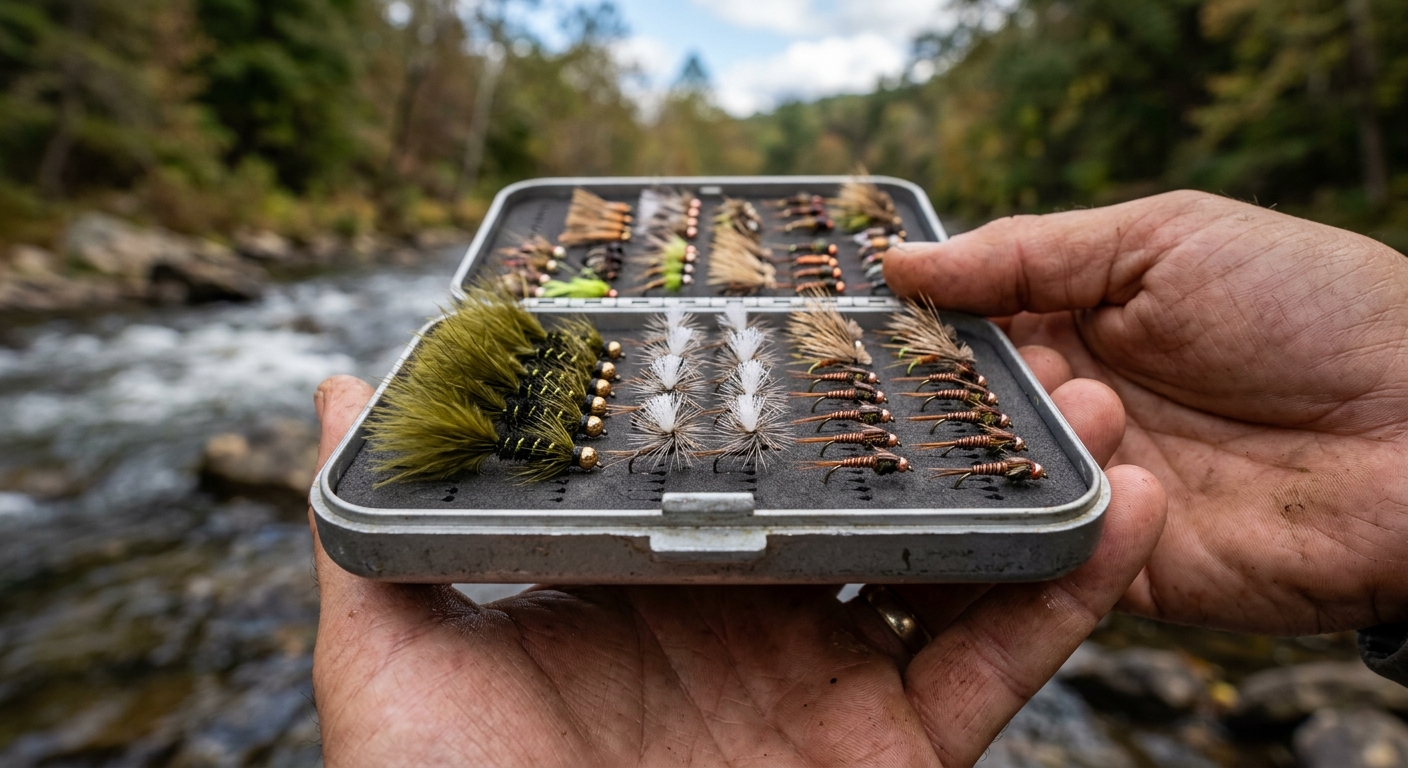
Fly selection paralyzes beginners because fly shops carry thousands of patterns and everyone at the counter speaks Latin. Ignore all of it. Three patterns catch fish everywhere in America:
- Woolly Bugger (olive or black, size 8). It looks like a leech, a minnow, a crayfish — like food, basically. Cast it across the current, let it swing, twitch it back. When nothing else works, the bugger works. If an angler could carry only one fly for the rest of their life, this is the consensus pick.
- Parachute Adams (size 14–16). The universal dry fly. It imitates most gray-ish mayflies, and the white post on top means you can actually see it on the water — which matters more than you'd think, because a dry fly you can't see is a dry fly you can't fish.
- Pheasant Tail Nymph (size 14–16, beadhead). Trout do about 80% of their eating underwater, and this little brown bug imitates almost everything drifting down there. Fish it under a small strike indicator (fine, it's a bobber, everyone knows it's a bobber) and set the hook whenever it does anything weird.
Buy three or four of each. You will lose them in trees. That's not failure, that's tuition.
Learning to Read Water
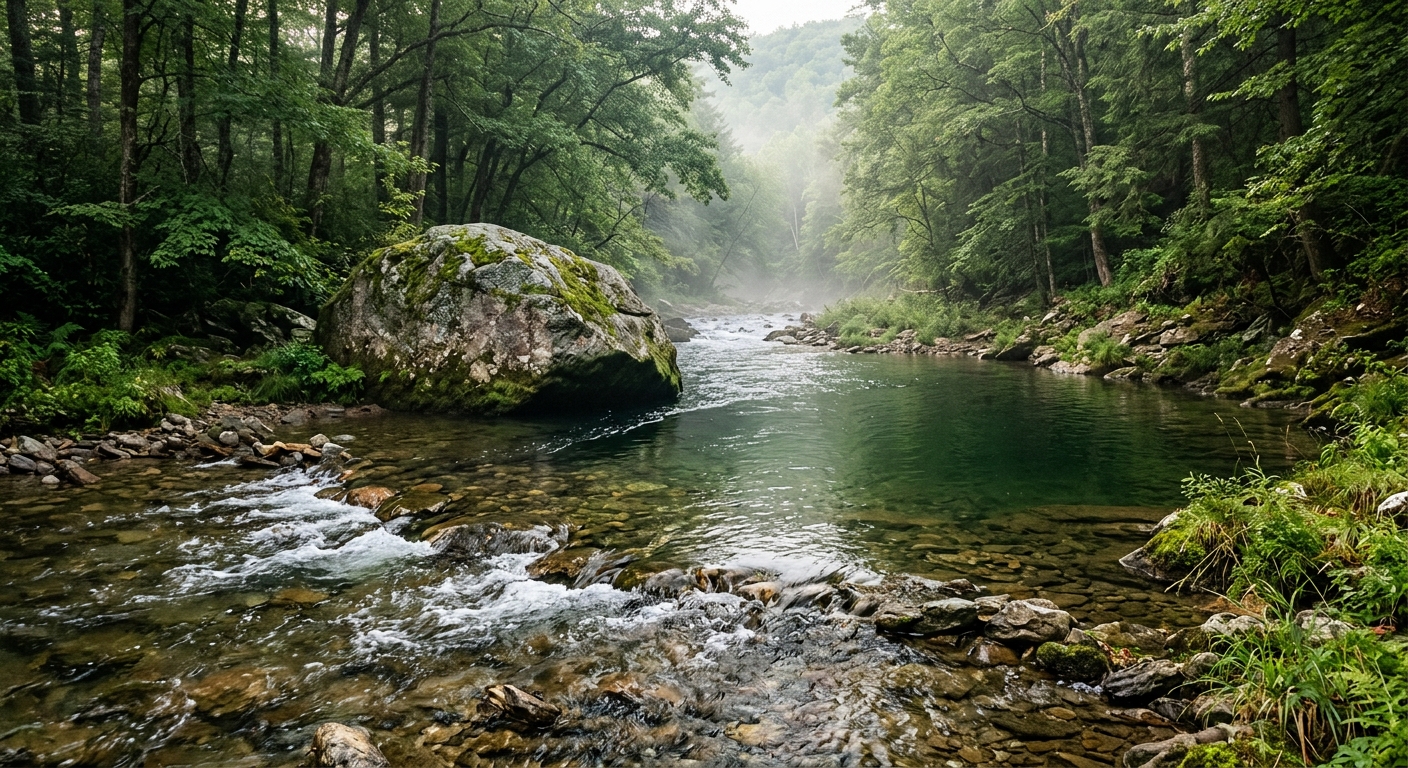
Trout are lazy in a calculated way: they want the most food for the least effort, with an easy exit if a shadow crosses the water. Once you know that, a river stops being a uniform sheet of water and turns into a map.
- Riffles — the choppy, shallow, fast stuff — are the food factory. Bugs live there. Fish the deeper water just downstream of them, especially early and late in the day.
- Seams are the lines where fast current meets slow. Fish hold in the slow lane and pick food out of the fast lane like a conveyor belt. If you learn to spot one thing, make it seams.
- Boulders act like windshields — water stacks up in front and leaves a quiet, cushioned pocket behind them. There is almost always a trout sitting in that pocket, waiting for the drift.
- Undercut banks and deep pools hold the biggest fish, especially midday when the sun is high.
A good habit: before you cast, stand still for two full minutes and just watch. It feels like wasted time. It's the highest-value two minutes of your day.
Casting Is a Rhythm, Not a Power Move
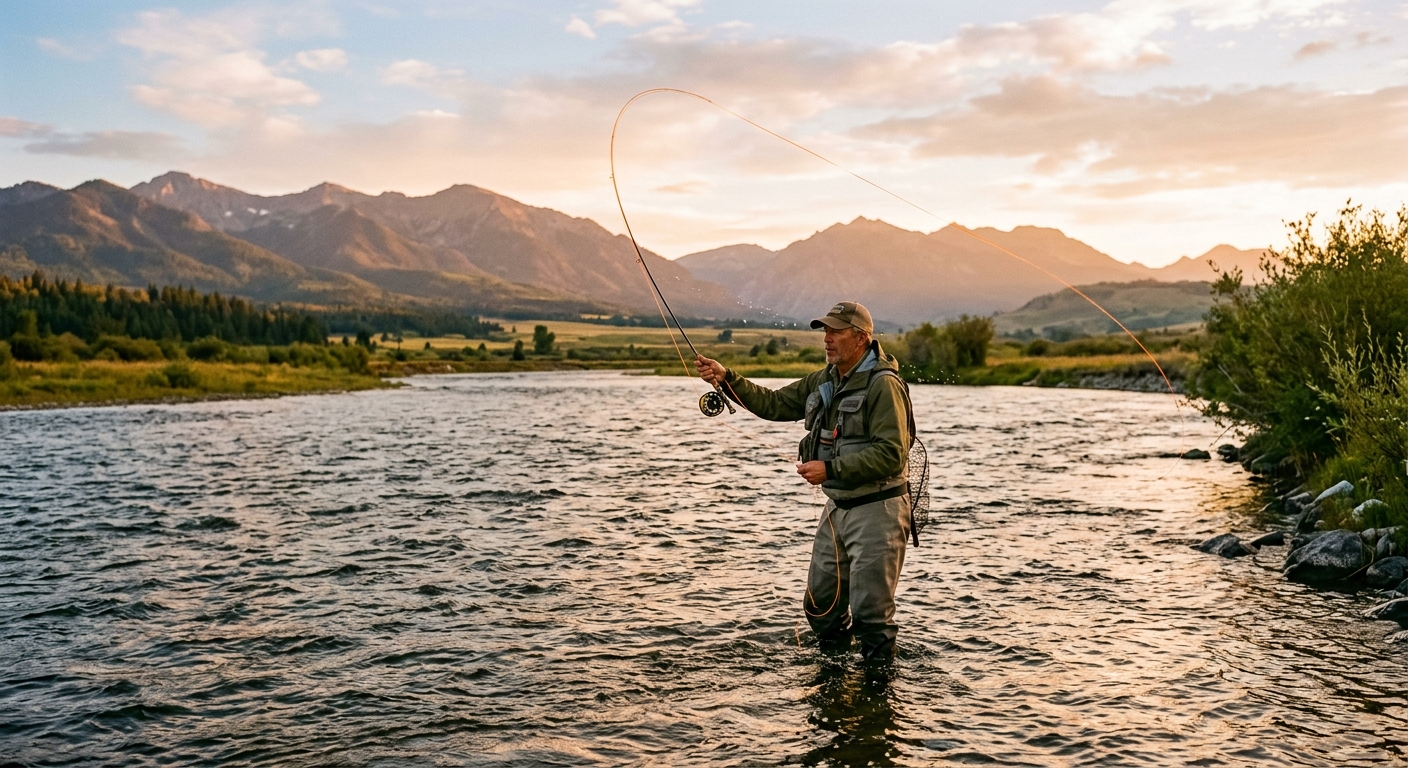
Every beginner tries to muscle the cast, and every beginner's line lands in a pile. Here's the mental shift that fixes it: in regular fishing, the lure's weight pulls the line off the reel. In fly fishing, the line itself is the weight. Your job is not to throw hard — it's to let the line load the rod, like a metronome with a pause at each end.
Three things fix most beginner casts:
- Stop the rod high behind you — pretend you're hanging up a phone on a wall — and wait. That pause lets the line straighten out behind you. Rushing it is the number one beginner mistake, and you can hear it: a whip-crack sound means you just snapped your fly off.
- Ten and two. Your rod tip should travel between roughly ten o'clock and two o'clock. Big sweeping arcs feel powerful and drop the line in a pile at your feet.
- Twenty feet is plenty. Most trout are caught within twenty-five feet. A short, accurate, gentle cast beats a long dramatic one every single time. Practice in a park for twenty minutes before your first trip — grass casting is free and nobody actually judges you.
If you can afford one splurge, make it a half-day casting lesson instead of a nicer reel. It compresses a year of frustration into three hours.
Catch and Release, Done Right
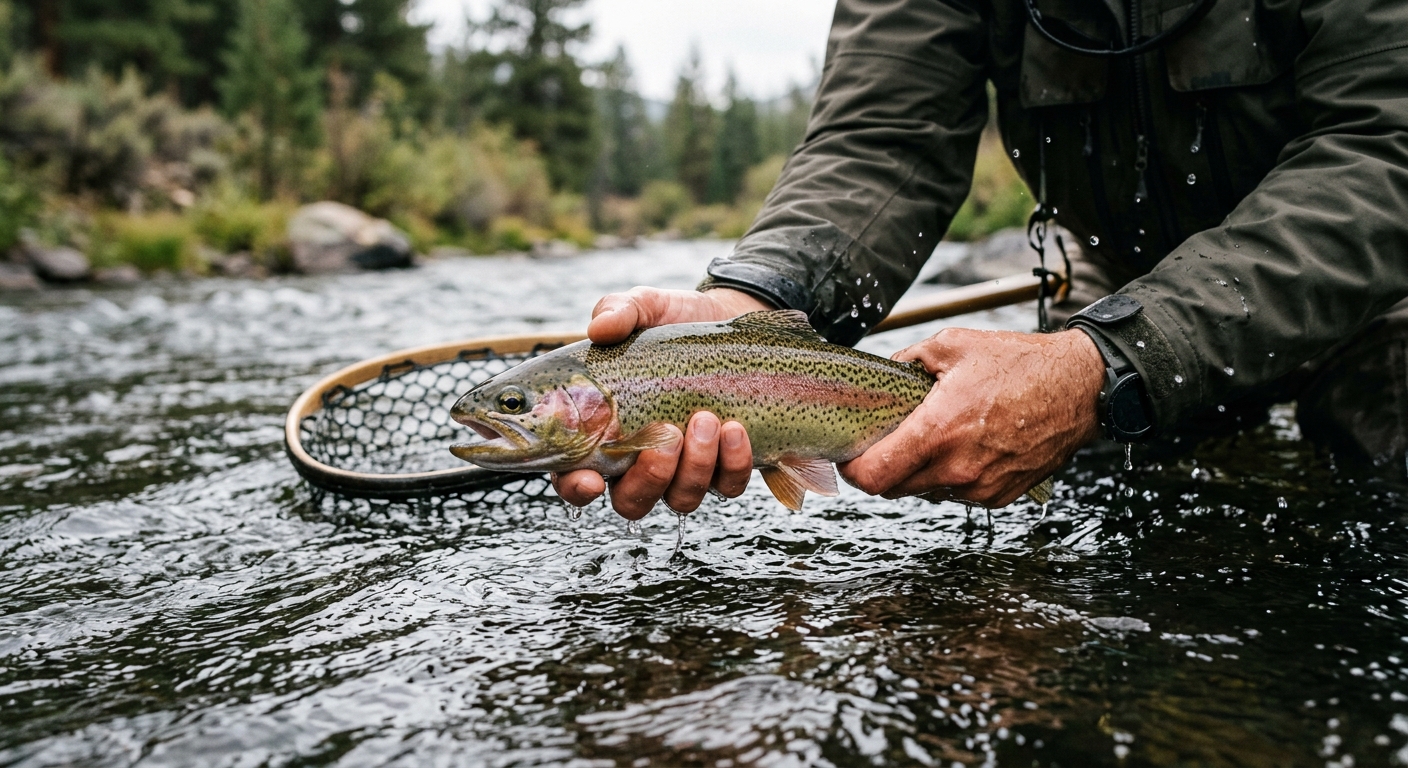
Most trout water is catch-and-release, either by law or by culture, and doing it well matters — a badly handled trout can swim away and still die an hour later. The rules are simple:
- Pinch your barbs flat with pliers. The fish barely notices the hook coming out, and someday you'll be grateful when the fly is in your ear instead.
- Wet your hands first. Dry hands strip the protective slime layer that keeps fish healthy.
- Keep them wet. The guideline we like: hold your own breath when the fish leaves the water. When you need air, so does the trout. Better yet, unhook it in the net without lifting it at all.
- Face it upstream to revive it in gentle current, and let it swim out of your hands on its own schedule.
Skip the grip-and-grin photo on hot days. Above about 68 degrees, water holds so little oxygen that a fight alone can kill a trout — good anglers just stop fishing for them and go find a bass pond.
The License Part (Boring, Required, Five Minutes)
You need a state fishing license, full stop, and the game wardens on popular water do check. The good news: it takes five minutes on your state's fish and wildlife website, costs $25 to $50 a year for residents, and the money funds habitat work and stocking programs — it's the best conservation money you'll spend. Some states tack on a trout stamp; the checkout page will tell you. Take a screenshot so you have it offline, and spend two minutes scanning the regulations for your specific stretch of water — rules can change from one bend of the river to the next.
Where to Actually Go First
Do not start on the famous technical tailwater an hour away, the one with the PhD trout that inspect every fly like customs agents. You'll get skunked, and worse, you'll conclude you're bad at this. You're not — you just picked graduate school before kindergarten.
Start here instead, in roughly this order:
- A stocked pond or panfish lake. Bluegill are aggressive, everywhere, and genuinely fun on a fly rod. They'll forgive a cast that lands like a dropped skillet and teach you hook sets, line management, and fish handling in a single afternoon.
- A slower, wider river with stocked trout. Your state wildlife agency publishes stocking schedules online — fish within a week or two of a stocking date. These fish eat confidently, and confident fish build confident anglers.
- Then the technical water, once setting the hook is a reflex instead of a decision. Those rivers reward skills you'll actually have by then.
One more trick: your state agency's website and local fly shops both give away information that guides charge for. Walk into the shop, buy your leaders and a few flies there, and ask what's working. Fly shop people love beginners who ask honest questions.
The Part Where It Gets Its Hooks in You
Here's what nobody warns beginners about: fly fishing rewires how you see rivers. You'll drive over bridges and involuntarily scan for seams. You'll check bug hatches like weather. Somewhere around your tenth trip, a trout will sip your parachute adams off the surface in slow motion, and you will make an involuntary noise you're not proud of. That's the moment. That's why the patient old-timers are still out there.
When you're ready to pick up that first combo, some waders, or a decent pair of polarized glasses, consider shopping through Epic Outdoor's retailer links — REI, Simms, Patagonia, and more. Every dollar you spend earns entries into our gear sweepstakes, so the kit you were buying anyway also buys you a shot at a much bigger haul. No purchase necessary — see the Official Rules for free entry details. No pressure either way — the fish don't care where your rod came from. See you on the water.