Crest Logan Pass at 6:40 on a July morning and there's a decent chance a mountain goat will be standing in the middle of the parking lot like it owns the place. (It does, honestly.) The sun will just be starting to hit the Garden Wall, the air hovering around 40 degrees even in midsummer, and you'll stand there with your coffee thinking the same thing every single person thinks the first time they see Glacier: why did I wait so long to come here?
Glacier is a million acres of jagged rock and ancient ice jammed up against the Canadian border, and it absolutely punishes people who try to wing it. Show up without a strategy and you'll spend your vacation circling parking lots and staring at "Lot Full" signs. Show up with one and you'll have turquoise lakes, ridgeline trails, and huckleberry pie mostly to yourself. This is the plan worth having before a first trip.
First, the Paperwork: Vehicle Reservations
Let's get the least fun part out of the way. Glacier uses a vehicle reservation system in peak season, and it catches people off guard every single year. In recent summers, you've needed a timed-entry vehicle reservation (booked on Recreation.gov) to drive the west side of Going-to-the-Sun Road during peak hours — roughly 7 a.m. to 3 p.m. — with a chunk of reservations released months in advance and a smaller batch dropping the day before at 7 p.m. Mountain Time.
The details shift a bit every year, so check the park's current rules before you book anything else. But here's what doesn't change:
- A reservation gets your car in the gate. It does not get you a parking spot. Those are two separate battles.
- Enter before the reservation window starts or after it ends and you don't need one at all. This is the loophole that shapes our entire strategy below.
- Lodging and some activity bookings inside the reservation zone often count as your reservation. If you're staying at a lodge inside the park, you may be exempt for that area.
If you strike out on reservations, don't panic. Early entries, evening drives, and the east side of the park will still fill your week.
Going-to-the-Sun Road: The Main Event
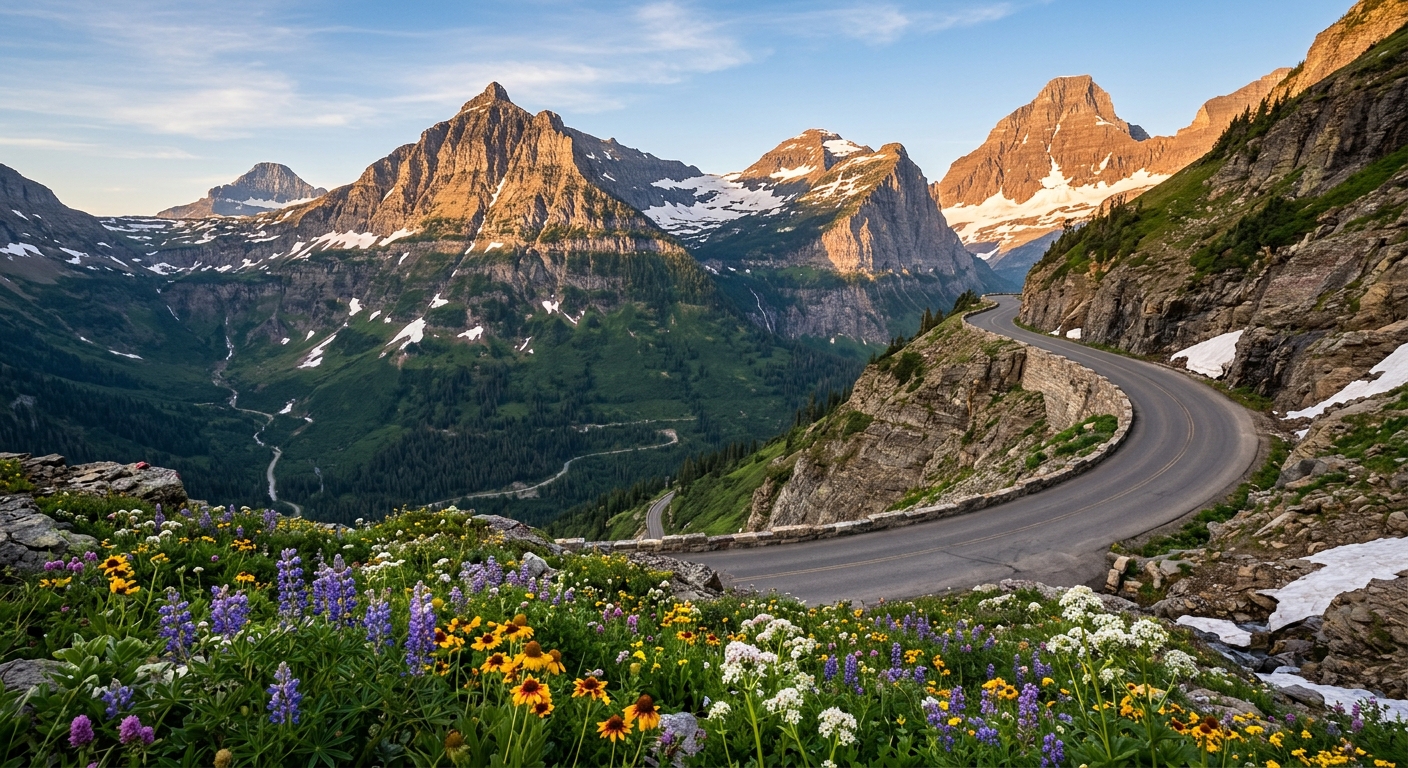
Fifty miles of narrow, white-knuckle asphalt chiseled directly into the side of a mountain. Going-to-the-Sun Road climbs from cedar forest at Lake McDonald, hugs a cliff face along the Garden Wall, tops out at Logan Pass (6,646 feet), and drops down to the windswept east side at St. Mary. It is, without exaggeration, one of the great drives on the planet.
The catch: it's only fully open for a short window. Plows start working in April, but the alpine section over Logan Pass typically doesn't open until late June or early July, and it can close again by mid-October. In recent decades it has opened as early as mid-June and as late as mid-July. If your trip is in June, have a backup plan; if it's late July through September, you're almost certainly fine.
The Logan Pass Parking Game
Logan Pass has the most coveted parking lot in Montana, and it's full by 7 a.m. most summer days. Here's how to actually win:
- Arrive before 7 a.m. Yes, really. Set the alarm for 5, grab breakfast to go, and drive up in the soft morning light. You'll get a spot, you'll beat the reservation window, and you'll have the Hidden Lake boardwalk nearly to yourself. The wildlife is out, the light is unreal, and by the time you're back at the car at 11, the lot is chaos.
- Or arrive after 4 p.m. The lot slowly empties in the late afternoon, and a 5 p.m. start on Hidden Lake Overlook with golden-hour light is one of the best cheap thrills in the park. Just carry a headlamp and layers.
- Or skip your car entirely. The free park shuttle runs the length of the road in summer. It's slower and the lines can be long midday, but it turns the Highline Trail into a point-to-point hike instead of a logistics puzzle.
Between 8 a.m. and 3 p.m.? Honestly, just be somewhere else. That's what the rest of this guide is for.
The Hikes That Earn the Hype
Glacier has 700-plus miles of trail, but if this is your first trip, don't try to be a contrarian. The classics are legendary because they're mind-blowing — just take the stats seriously, because they'll also kick your legs out from under you if you underestimate them.
Highline Trail — 11.8 miles, the best day hike in America?
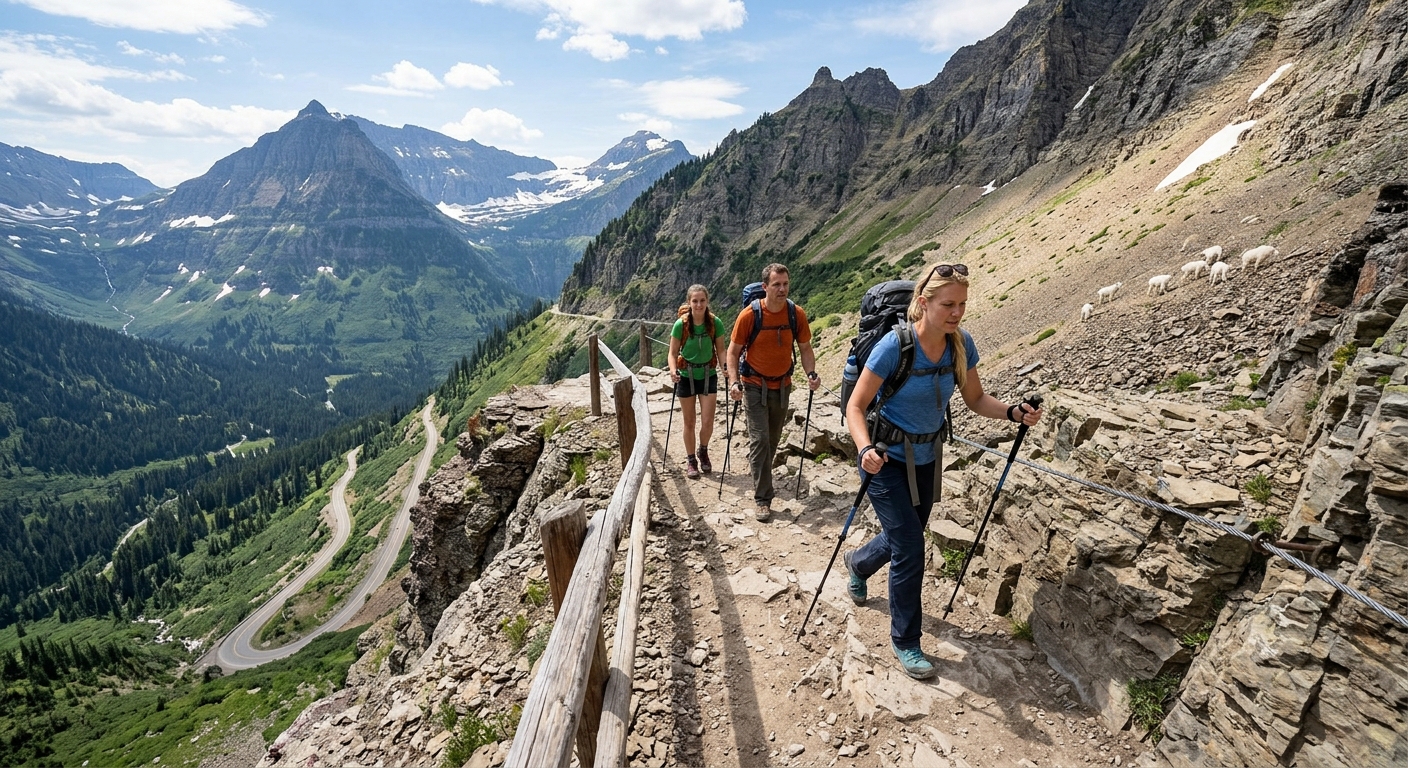
The Highline starts directly across from the Logan Pass lot and traverses the Garden Wall — a narrow ledge (there's a hand cable for the nervous first quarter mile) that opens into miles of wildflower meadows suspended above the road. Mountain goats and bighorn sheep are basically guaranteed. Most people hike it point-to-point: 11.8 miles from Logan Pass to The Loop, then ride the shuttle back up. The elevation profile is gentle by Glacier standards, but nearly 12 miles at elevation is a full day. Of all the famous trails in all the famous parks, the Highline is the one people daydream about at their desks.
Grinnell Glacier — 10.6 miles, 1,600 feet of climbing
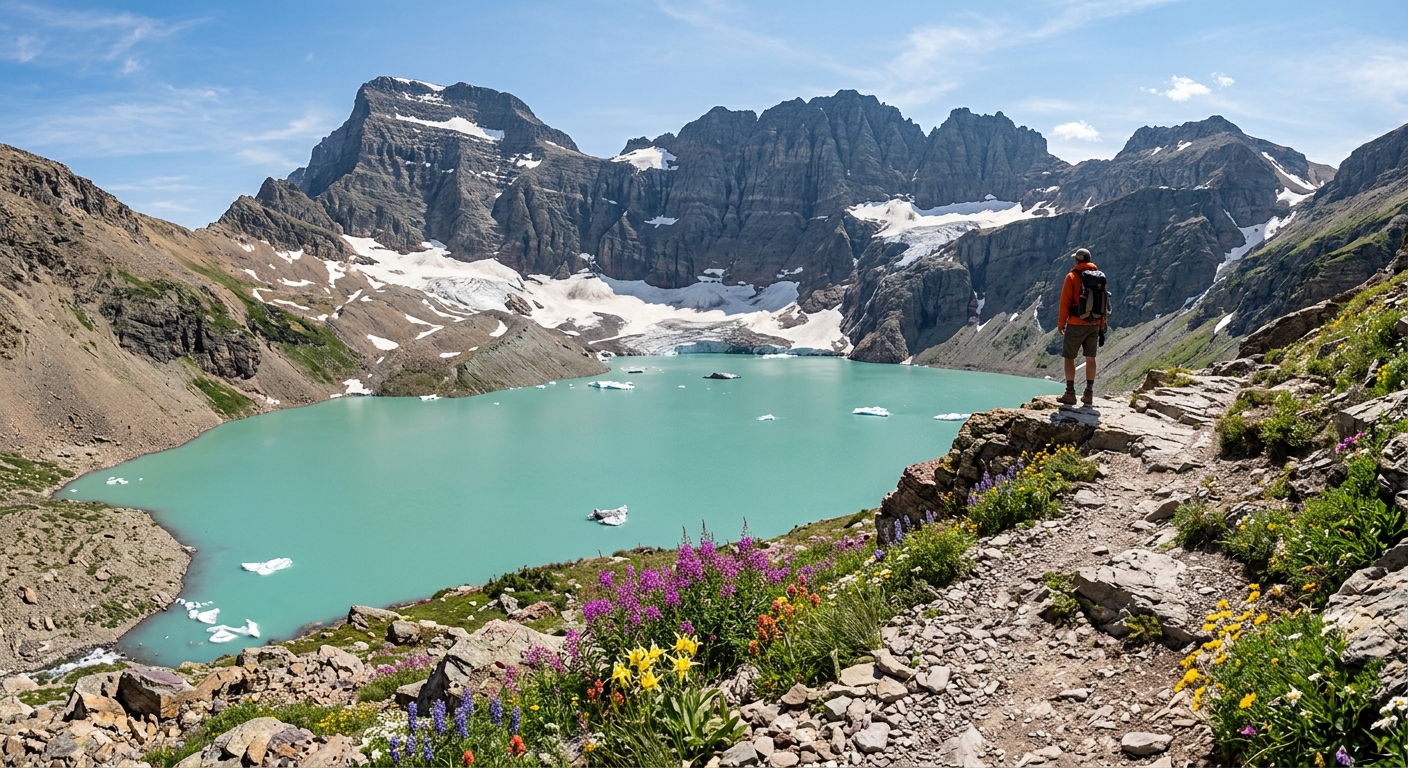
This is the east side's crown jewel, starting from the Many Glacier valley. You climb steadily past a stack of impossibly turquoise lakes — the milky teal color is real, it's rock flour from the grinding ice — until you're standing at the foot of an actual glacier with icebergs bobbing in the meltwater. It's 10.6 miles round trip with about 1,600 feet of gain, and you can shave roughly 3.4 miles by taking the historic boat shuttle across Swiftcurrent and Josephine lakes (book ahead — it fills). Fair warning: this valley is grizzly central. More on that below.
Avalanche Lake — 5.9 miles, bring the kids
This is the family hike, and it doesn't feel like a consolation prize. You start on the wheelchair-accessible Trail of the Cedars boardwalk through an honest-to-goodness old-growth cedar grove, then climb gently along Avalanche Creek's slot gorge to a lake ringed by 2,000-foot walls with waterfalls threading down them. It's 5.9 miles round trip with modest gain — very doable for grade-schoolers with a couple of snack-related negotiations budgeted in. Go early or late; the trailhead parking is nearly as competitive as Logan Pass.
Hidden Lake Overlook — the biggest payoff per mile
From the Logan Pass visitor center, a boardwalk-and-trail route climbs about 1.4 miles through alpine meadows to an overlook of Hidden Lake with Bearhat Mountain standing over it like a movie set. Roughly 2.8 miles round trip. Goats lounge on the boardwalk. Snow lingers on this trail well into July, so don't be surprised to cross a few snowfields in sneaker weather — traction and trekking poles (Black Diamond makes our favorites) turn slippery into fun.
Bear Safety, Done Right
Glacier has one of the densest grizzly populations in the Lower 48, and the good news is that bear safety is mostly about doing a few boring things consistently:
- Carry bear spray on your hip or chest strap — not in your pack. A charge happens in seconds. If your spray is buried under your rain shell, you don't have bear spray, you have expensive ballast. Buy it in Montana (you can't fly with it), and practice pulling the safety clip.
- Hike in groups and make noise. Almost every bad encounter starts with a surprised bear. Talk, clap around blind corners and near loud streams, and call out a cheerful "hey bear" more often than feels dignified. Groups of three or more are statistically much safer.
- Give every bear the right of way. 100 yards minimum. If a bear is on the trail, your hike now includes a long snack break.
- Never leave food unattended. In camp, that means bear boxes or a proper hang, every time.
None of this should scare you off. It's a routine, like putting on a seatbelt — and seeing a grizzly flip rocks in a meadow at a safe distance will be the highlight of your trip.
Where to Stay (Book Absurdly Early)
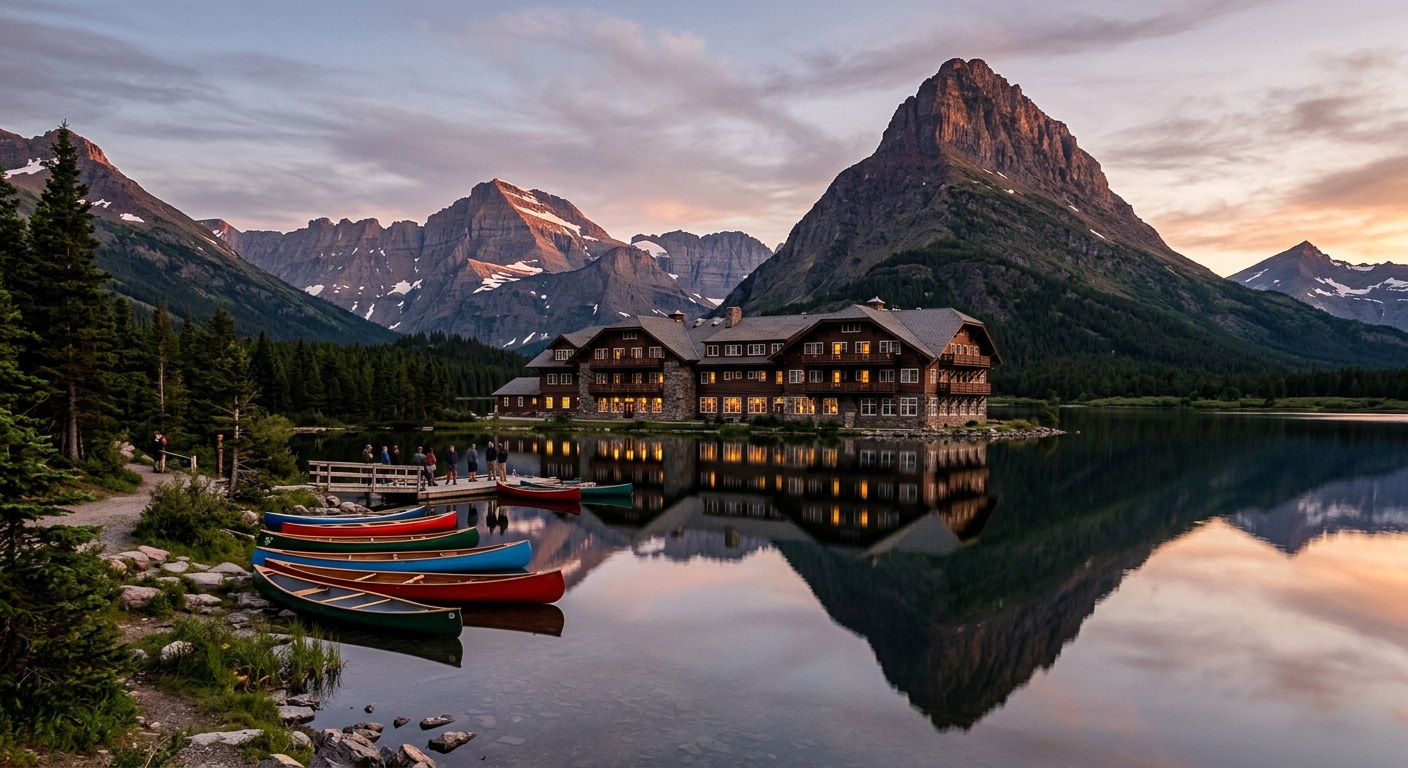
Here's the number that surprises everyone: the historic lodges inside the park open reservations 13 months in advance, and the best rooms go within days. If you want to stay at Many Glacier Hotel next July, you should be booking this June. Set a calendar reminder now.
Your three main base camps:
- Many Glacier (east side) — Our pick, and it's not close. You wake up inside the postcard: the hotel sits right on Swiftcurrent Lake, moose browse the willows, and the Grinnell Glacier and Iceberg Lake trailheads are steps away. The tradeoff is remoteness — it's a long, slow drive from everything else, and services are minimal. That's the point.
- Lake McDonald (west side) — The classic. Lake McDonald Lodge is a 1913 Swiss-chalet time capsule on the park's biggest lake, with easy access to Trail of the Cedars, Avalanche Lake, and the west entrance of Going-to-the-Sun Road. More sheltered, more forested, more convenient.
- West Glacier (gateway town) — Outside the entrance, with the widest range of hotels, rentals, rafting outfitters, and dinner options. If lodge reservations slipped through your fingers (or your budget), this is the practical move — you can still do everything, you'll just drive a bit more and want that pre-7 a.m. start even more.
Campers: Many Glacier, Fish Creek, and St. Mary campgrounds are reservable and go fast; Apgar is huge and your best last-minute hope.
East Side vs. West Side
They genuinely feel like two different parks. The west side is Pacific Northwest lush — cedar forests, mossy creeks, mellow lake mornings, and most of the crowds, since it's closest to Kalispell's airport. The east side is where the Rockies slam into the prairie: bigger views, harsher wind, fewer people, and the best trailheads in the park (Many Glacier and Two Medicine). The east side borders the Blackfeet Nation, and the drive up Highway 89 with the mountain front on your left is a sneaky highlight all by itself.
Our advice: split your nights. Three on the west, three on the east, drive Going-to-the-Sun Road on the switch day. Don't try to "day trip" Many Glacier from West Glacier — that's four hours of driving for a place you'll wish you'd slept in.
Eat the Huckleberry Everything
You will not escape the huckleberry, and you shouldn't try. This wild mountain berry (it has never been successfully farmed, which is why it's a local obsession) shows up in pie, ice cream, milkshakes, jam, lemonade, barbecue sauce, and margaritas. The bears love them as much as you will — late-summer berry patches are exactly where you want to be making noise. Our completely unscientific ranking: the huckleberry ice cream at a lodge after a 10-mile day beats everything else on the menu, and a jar of jam is the only souvenir anyone actually uses.
The Shoulder-Season Question
June and September/October are tempting, and they're genuinely great — with eyes open:
- June: Waterfalls at full throttle, green valleys, few crowds early in the month. But Going-to-the-Sun Road is probably still closed over Logan Pass, high trails are snowbound, and the Highline typically doesn't melt out until July. June is a lakes-waterfalls-and-valleys trip, not an alpine one.
- September: Our favorite month. Crowds thin dramatically after Labor Day, the larch and aspen start turning gold, huckleberries linger at elevation, and the light gets long and dramatic. The tradeoffs: lodges and shuttles start shutting down mid-month, some services close, and the first snow squall can arrive any time. Pack real insulation — a warm puffy (Patagonia or similar) and wool layers (Smartwool) aren't optional up high.
- October: Beautiful, moody, and mostly closed. For experienced, self-sufficient visitors only.
If you want the full postcard experience — road open, trails melted out, boats running — aim for mid-July through early September and embrace the early alarms.
What We'd Pack
Nothing exotic, but Glacier's weather is notoriously moody — August snow squalls are a documented park tradition. Here's the kit that makes sense:
- The pack: An Osprey Talon has room for layers, water, and lunch without feeling like luggage; a Hyperlite Mountain Gear pack is the move for fast-and-light days.
- Footwear: Leave the heavy leather boots at home. Nimble trail runners or light hikers with sticky rubber — Salomon is a reliable place to start — handle wet shale and lingering snow patches without punishing your knees on the long descents.
- The essentials: A bombproof rain shell no matter what the forecast says, sun protection for the exposed east side, a water filter, and trekking poles for the way down.
REI is a solid one-stop if you're starting from scratch — and there's a store in Kalispell if your airline eats your bag.
If you do need to pick up gear before you head out, shop through the retailer links here on Epic Outdoor — every dollar earns you entries into our gear sweepstakes. No purchase necessary — see the Official Rules for free entry details. You were going to buy the bear spray holster anyway; might as well get a shot at winning your next trip's kit while you're at it.
Set the alarm for 5. The goat will be waiting.