Picture a first paddleboard outing: 7:00 AM on a glassy Adirondack lake, the only sounds a loon somewhere in the mist and the drip of water off the paddle blade. Ten minutes later, the paddler is swimming — fully clothed, phone mercifully in a dry bag — because a bass boat's wake arrived at the exact moment they turned around to look at an eagle. Then they climb back on, laughing, and paddle another two hours. That's flatwater paddling in a nutshell: absurdly peaceful, occasionally humbling, and easier to get into than almost any other outdoor sport.
If you've been eyeing the water this summer and wondering whether you're a kayak person or a paddleboard person, this one's for you.
Kayak or SUP? The Honest Comparison
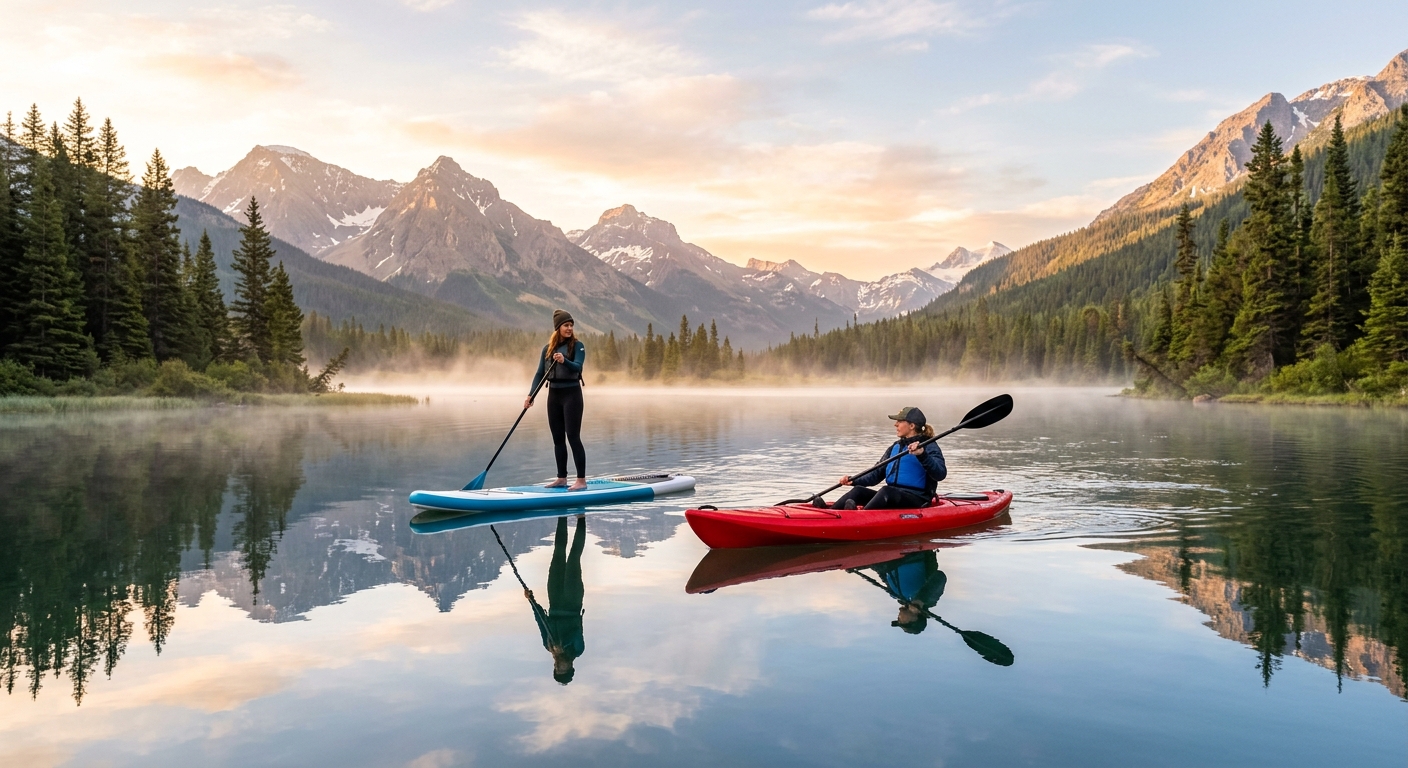
It's the first question every friend asks, and the honest answer is: it depends on what you want out of your time on the water. Plenty of paddlers end up keeping both in the garage for a reason. This is how we help people choose.
Stability: Kayaks win, and it's not close. You're sitting down with a low center of gravity, so even a twitchy kayak feels more secure than a wide SUP. On a paddleboard you're standing on water, and your ankles and core are making a hundred tiny corrections a minute. That said, don't let fear of swimming scare you off the board — a wide 10'6" cruiser SUP is far more stable than it looks, and most first-timers stay dry unless a boat wake sneaks up on them. Still, almost nobody flips a recreational kayak on flat water without really trying.
Storage: Kayak again. A sit-on-top rec kayak has tank wells and bungees for a cooler, tackle, and a dry bag. A SUP has a few bungee cords up front, and everything you strap there will get splashed. If your idea of a good day involves lunch, fishing gear, and a camera, the kayak is your pickup truck.
Workout: SUP, decisively. Paddleboarding is a sneaky full-body workout — core, legs, shoulders, balance. An hour of casual SUP paddling works you harder than two hours in a kayak. If you want your water time to double as exercise, stand up.
The dog factor: SUP, surprisingly. A 60-pound dog fits happily on the nose of a 10'6" board and most dogs figure it out in a session or two (yes, they make dog PFDs, and yes, you should get one). Fitting that same dog into a kayak cockpit is a wrestling match. If your lab is coming with you, get a board.
The vibe: This is real, even if it isn't on a spec sheet. Kayaking feels like traveling — you cover distance, explore shorelines, poke into coves. SUP feels like being somewhere — you drift, you look down and watch fish under your feet, you sit on your board and eat a sandwich. Neither is better. But one of them will sound more like you.
If You Go Kayak: Sit-on-Top vs Sit-In
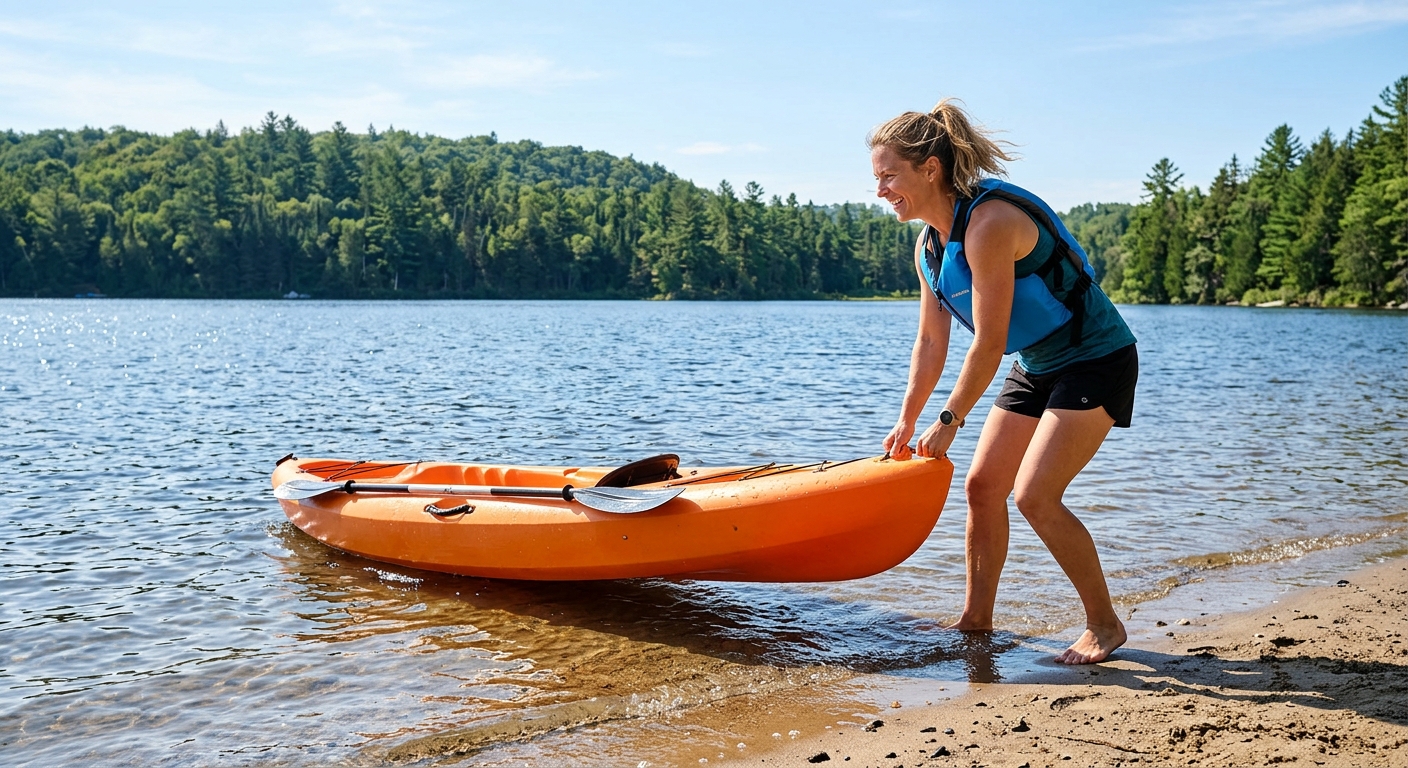
For your first kayak, this is the real decision, and for most beginners on lakes and slow rivers, we'd steer you to a sit-on-top. You're perched on a sealed, self-draining deck: if you flip, the boat doesn't swamp, and climbing back on is something you can actually do without a rescue course. You can slide off for a swim mid-paddle and slide back on. They're also easier to get in and out of at a dock. The trade-off is you will get wet — water drips off the paddle and splashes through the scupper holes — and they're slower.
A sit-in keeps you drier and warmer, sits lower in the wind, and paddles faster for the same effort. That matters in the Pacific Northwest or early-season New England, where the water is cold even when the air isn't. But if a sit-in flips, it fills with water, and emptying a swamped boat while treading water is a genuine skill. If you go sit-in as a beginner, stay close to shore until you've practiced a wet exit somewhere warm and shallow.
Rule of thumb: warm water, casual paddling, maybe some fishing — sit-on-top. Cooler water, longer distances, drier ride — sit-in, with practice.
Inflatable vs Hard Shell (Inflatables Are Legitimately Good Now)
Ten years ago, "inflatable kayak" meant a pool toy that folded in half when you paddled hard. That era is over. Modern drop-stitch construction — thousands of internal threads holding two layers of material at high pressure — makes inflatable SUPs and kayaks rigid enough that most beginners can't tell the difference on flat water. A quality inflatable SUP pumped to 15 PSI feels like a board, not a raft.
Inflatables are all about what happens off the water: they live in a duffel in your closet, fit in the trunk of a Corolla, and fly with you on vacation. No roof rack, no garage space, no wrestling 55 pounds of polyethylene over your head. Hard shells pay you back at the water instead — better glide, more responsive, and you skip the 8 to 10 minutes of pumping at the launch. If you do go inflatable, get a decent hand pump with a gauge, or spring for a 12V electric pump like the OutdoorMaster Shark II that runs off your car — your shoulders will thank you before you've even started paddling.
Our take: if you live in an apartment or drive a small car, get an inflatable and don't look back. Brands like NRS make inflatables tough enough for whitewater, so a calm lake is a Sunday stroll for them. If you have a garage and a rack, a hard shell rewards you every single outing with zero setup.
The PFD Is Not Optional
We're going to be direct about this one, because it matters: wear your life jacket. Not strapped to the deck, not "within reach" — on your body, zipped and buckled. The overwhelming majority of paddling fatalities involve someone who wasn't wearing one, and flat, warm-looking water is exactly where people let their guard down. Cold water shock is real, wakes show up out of nowhere, and a board or boat blows away from a swimmer far faster than you can chase it.
The good news is that modern paddling PFDs are nothing like the orange horse collars from summer camp. A proper paddling vest like the NRS Chinook (cut high in the back so it doesn't fight your kayak seat) or the low-profile NRS Ninja has big armholes cut for rotation and pockets for your whistle and lip balm — the kind of vest you forget you're wearing. Expect to spend $70 to $140 for one you'll actually keep on — which makes it the best money in this entire article.
One more note: in the US, the Coast Guard treats SUPs as vessels outside of swim zones, so a PFD isn't just smart, it's the law in most places. Kids' rules are stricter. Just wear it.
The Short List of Accessories That Matter
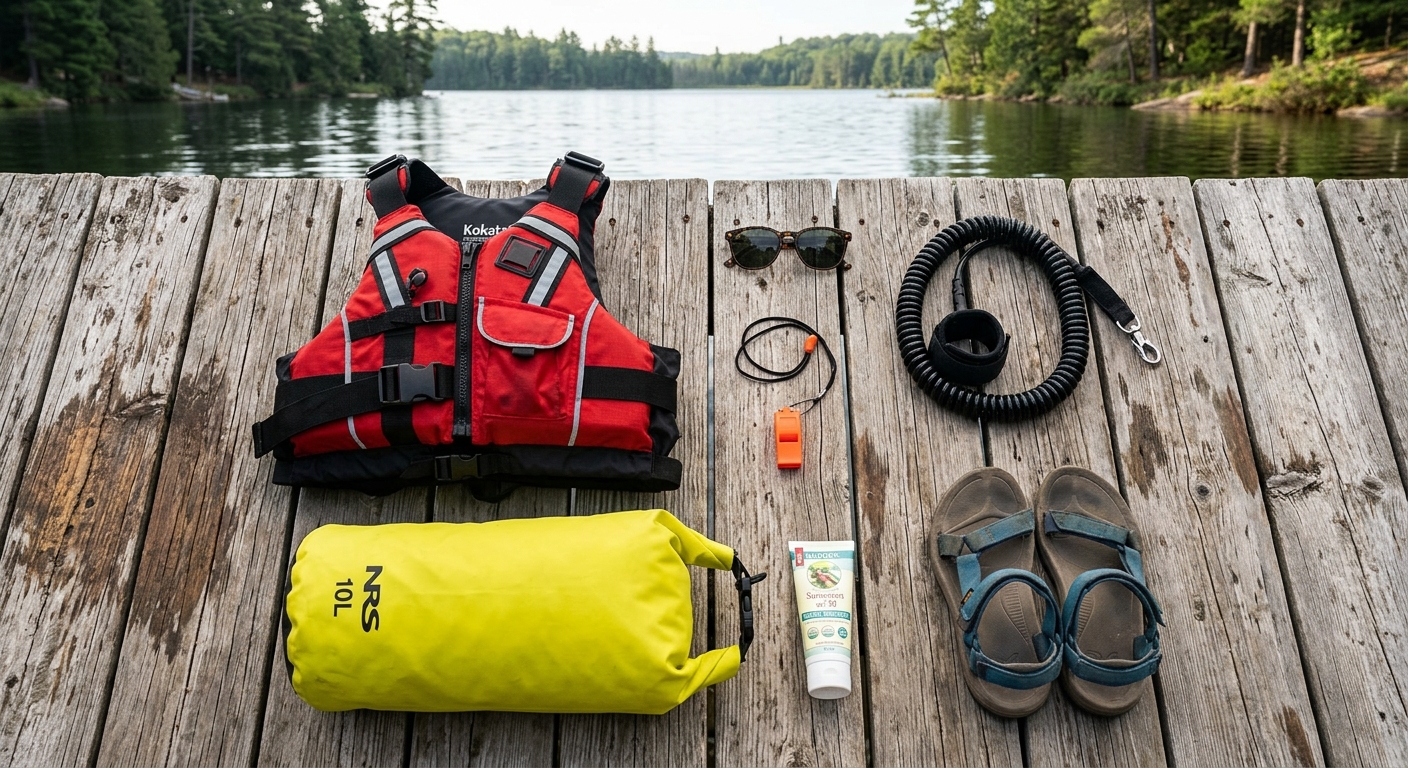
Paddling has blissfully little required gear, but these earn their place every single time:
- Dry bag (10-20L). Phone, keys, sandwich, spare layer. Roll it, clip it to the boat or bungees. An NRS Tuff Sack or an REI Co-op lightweight dry bag runs about $25-40 and will outlive your car.
- Leash (SUP only). A coiled ankle or calf leash keeps your board attached to you when you fall — and on a windy day, a loose board travels faster than you can swim. Non-negotiable on lakes. (Important exception: never wear a leash on a river with current; it can pin you.)
- Whistle. Three bucks, clips to your PFD, legally required in many states, and it carries across a lake far better than your voice. Three blasts means help.
- Water and sun protection. You're on a giant mirror. Polarized sunglasses on a retainer strap — Sunski makes great lightweight polarized pairs around $50-70, and the strap is what keeps them out of the lake — plus a hat and real sunscreen.
- Footwear. Launch sites are rocky, mucky, and full of surprises. A pair of KEEN Newport H2 sandals saves your soles and drains instantly.
- Something cold for after. Not required. Strongly encouraged. A YETI Hopper Flip 12 in the tank well of a sit-on-top is peak summer.
Getting It to the Water
If you went inflatable, skip ahead — your boat rides in the trunk. For hard shells, roof transport is simpler than it looks, but do it right, because a 12-foot kayak coming off a car at 65 mph is genuinely dangerous.
The gold standard is a set of crossbars with a cradle or J-hook carrier. Thule is our pick here — their Hull-a-Port J-cradles hold a kayak securely on its edge and fold down when empty, and their SUP Taxi locks a board flat with one buckle. Expect roughly $150-250 for crossbars if your car doesn't have them, plus $100-250 for the carrier. Foam block kits work in a pinch for short, slow drives, but they're a compromise.
Two rules regardless of setup: bow and stern lines, always — cam straps across the middle are not enough at highway speed — and give every strap a firm tug five minutes into the drive, because everything settles. Cam straps, never ratchet straps; a ratchet will crack a hull before you realize you're overtightening.
Reading Wind and Water (Flat Doesn't Mean Harmless)
Flatwater paddling is safe and beginner-friendly, with one big asterisk: wind. Wind is to a paddler what elevation is to a hiker — the thing that quietly decides how your day goes.
The pattern to burn into your brain is paddle into the wind first. Going out against a headwind feels like work; coming home with it feels like a gift. Do it the other way around and the second half of your day is a grind — or worse, on a SUP, a situation. A standing paddler is a sail: in a 15 mph breeze, you may not be able to make forward progress standing up. (If that happens: drop to your knees, choke up on the paddle, and grind it out. Kneeling cuts your wind profile in half.)
Before you launch, check the forecast for wind speed *and* direction, not just sun. Under 10 mph is lovely, 10-15 is work, over 15 is a no for beginners. Afternoons are almost always windier than mornings — that glassy 7 AM lake and the whitecapped 3 PM version are the same lake. And know the offshore wind trap: wind blowing from the shore out toward open water makes the water near your launch look deceptively calm, then pushes you further out with every minute. If thunderstorms are anywhere in the forecast, you're off the water at the first rumble; you are the tallest thing on a flat conductive surface.
Your First Outing: Small Tips That Make a Big Difference
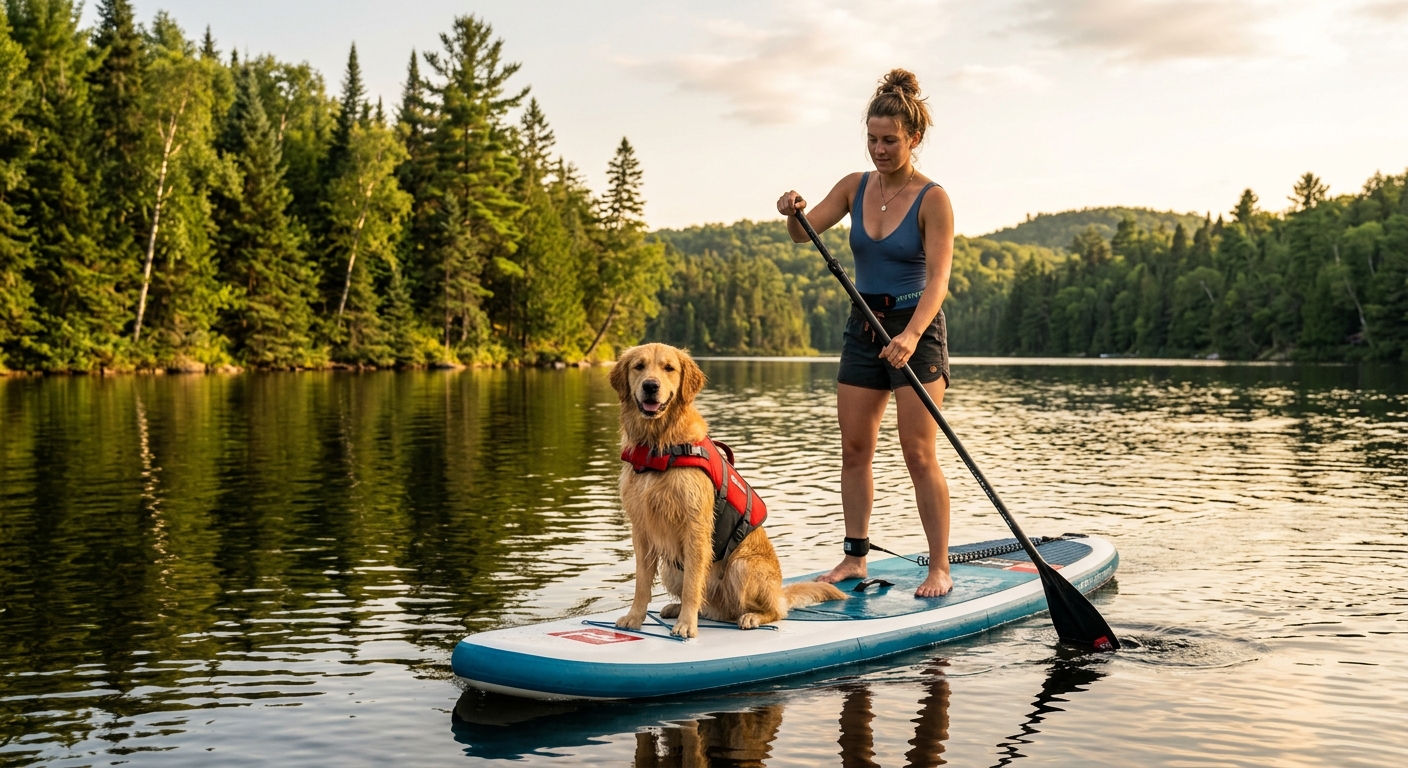
- Pick a boring launch spot. A small lake or pond with a sandy put-in, no motorboat traffic, and no current. State park beaches are perfect. Save the river for trip three.
- Stay within swimming distance of shore. Paddle a lap of the shoreline rather than beelining for the middle. You see more anyway — herons, turtles, other people's questionable dock construction.
- Sunscreen the tops of your thighs. We mean it. Sitting in a kayak, your quads face the sun for two straight hours, and they are not used to it. The first-timer thigh burn is a rite of passage nobody needs. Tops of feet too, SUP folks.
- Dress for the water, not the air. A 75-degree June day on a 58-degree lake means you dress expecting a swim.
- Start on your knees (SUP). Paddle out kneeling, get a feel for the board, then stand up one foot at a time where the water's deep enough to fall. Look at the horizon, not your feet — same trick as riding a bike.
- Tell someone where you're going. Even for an hour. It's a habit, not a hassle.
- Keep the first one short. Ninety minutes is a great first paddle. You want to come off the water wanting more.
Rent Before You Buy
This is the advice we give friends most often and the advice they ignore most often: rent first. A rental is $20-40 an hour at most lakes, and two or three sessions will teach you more about what you actually want than a month of reading reviews. You might discover you're a kayak person after all. You might discover you're a "kneeling on a SUP with a dog and a sandwich" person. Both are great data points that cost less than a returned $800 board.
Rent different styles on purpose — a sit-on-top one weekend, a SUP the next. Many shops (and REI stores with boathouse programs) will put your rental fees toward a purchase. And when you are ready to buy, evo runs excellent paddle gear sales in late summer, when this year's boards get marked down and the water's still warm for months.
Get Out There
The lake doesn't care whether you're on a kayak or a board, whether it's inflatable or fiberglass, whether your stroke is textbook. It just has to be 7 AM, glassy, with a loon somewhere in the mist — and you, finally, out on it.
And if you do end up picking up a PFD, a leash, or eventually the boat itself, shopping through Epic Outdoor's links to REI, NRS, evo, and the rest automatically earns you entries in our gear sweepstakes — no extra cost, no pressure, just a bonus shot at winning the whole quiver on gear you were getting anyway. No purchase necessary — see the Official Rules for free entry details. See you on the water.